
Few Nigerian homes are bought with a mortgage. We look at why prices, incomes and the cost of money make borrowing hard, and how to apply with a better chance of approval.
A mortgage should make a home easier to buy by spreading the cost over many years. In Nigeria, few home purchases are financed that way. Most buyers pay from savings or in instalments to a developer.
The reasons sit deeper than bank paperwork. They come from what it costs to build, what people earn, and what money costs to borrow. Knowing them makes it easier to understand why a mortgage may not work for you right now—or, if it can, to apply with a better chance of approval.
Prices, income and location
In Lagos, the first hurdle is the price of the home itself. Cement, steel, finishing and infrastructure are expensive, and land in well-connected areas carries a large premium. Banks typically accept repayments of up to about 33% of monthly income, and only a small group of earners can carry a big loan within that limit. Above that, the repayment leaves too little to live on, and you cannot eat bricks and mortar.
Moving away from the big cities does not necessarily fix this. Cheaper land can reduce the purchase price, but construction costs remain substantial. Materials, transport, infrastructure and site conditions all affect what it takes to deliver a home.
Where earning opportunities are also lower, the affordability gap may persist. A buyer may face higher prices alongside higher pay in one location, and lower prices alongside lower pay elsewhere. The relationship between the price and the buyer’s income matters more than the price alone.
Interest rates and the cost of money
High interest rates shrink the loan a buyer can qualify for. They are not just a bank’s choice. They reflect what money costs across the economy: lenders put capital where it earns the best return for the risk, and price loans accordingly.
There is also a question about how long-term mortgages should be funded and priced. A mortgage can run for 15 to 20 years, but longer-term borrowing does not always carry a higher rate than short-term borrowing.
A March 2026 market report, for example, put yields on FGN bonds with approximately one year remaining to maturity at about 19.8%, compared with about 16% for those with five years remaining. That was a snapshot of the government bond market, rather than evidence of how individual banks price mortgages. (Nairametrics)
Still, it raises a reasonable question: could better access to long-term funding bring mortgage pricing closer to comparable long-term benchmarks, with a clearly explained margin for lending risks and costs?
Lenders must account for credit risk, liquidity, operating costs and early repayment. Our view is that the funding structure deserves attention alongside the interest rate charged to the buyer. Until borrowing becomes more manageable relative to income, the loan available to many buyers will remain too small.
Proving your income and qualifying the property
Even when the numbers work, a lender has to approve two things: you and the building.
Your income, on paper. Earning money and proving it to a lender are different things. Lenders look at regular, traceable inflows, the debts you already carry, and the deposit you bring. The Nigeria Mortgage Refinance Company (NMRC) sets out these principles in its underwriting guidance.
The property’s title and stage. The property must meet the lender’s requirements on documentation, approvals and construction stage. For a home still being built, you need to know when the bank can value it, check the documents and release funds.
Before you apply, it helps to:
Keep clear bank statements and income records for the period your chosen lender requires.
Reduce other debts where practical and keep repayments up to date. Outstanding debts and missed repayments can affect your credit assessment, including borrowing through digital lending platforms.
Ask the developer for the title documents and approvals early, and share them with the bank.
How the mortgage route works at Crescent Apartment
For a developer, the timing of payments decides how smoothly a building goes up. For a buyer, the biggest risk is paying a deposit without knowing whether, or when, the loan for the balance will come through.
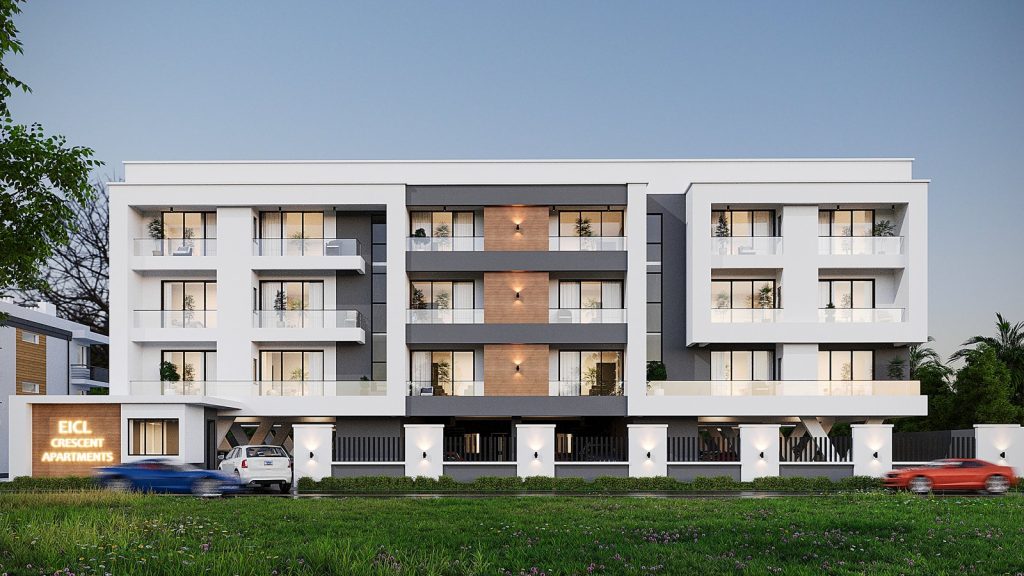
At Edheka Investment Company Limited (EICL), we have set up the mortgage route for Crescent Apartment, Alpha Beach, Lekki, around how Nigerian mortgage lenders actually assess and pay out loans:
You open an account with our partner mortgage bank and pay your deposit (about 30% of the price at most banks) into that account rather than to us.
The bank checks you and the property early, while your deposit builds up, so you learn whether you qualify before the full amount is committed.
Once its conditions are met, the bank pays the balance to the project.
You repay the bank directly, on the schedule agreed with it.
Your deposit sits with a regulated bank, and the approval runs alongside the building work rather than at the end. If you would rather not borrow, the standard plan of 40% on signing, 30% at roofing and 30% at handover remains available.
Talk it through with us
If you are considering a home at Crescent Apartment, we can walk you through the deposit, the bank’s onboarding steps and the full repayment schedule before you commit. Kindly contact us to arrange a site visit.
WhatsApp 0802 252 9517 · investments@edheka.com · www.edheka.com
Related insights

Why Apartment Size Still Matters
Square metres tell you how large an apartment is. They don’t always tell you how well that space will live.
26 September 2026
Buying Off-Plan: What Should You Actually Look For?
An editorial guide to the information behind a purchase decision.
26 September 2026
The Price of a Home Is Only Part of the Purchase Decision
Why payment structure belongs alongside the headline price.
26 September 2026